Pulse begins with a simple question: what changed?
Opening an app and finding a long list of numbers does not necessarily mean you understand the home. Laro Pulse is designed to bring the essential signals into a status that is easy to read: what is normal, what changed and what deserves attention.
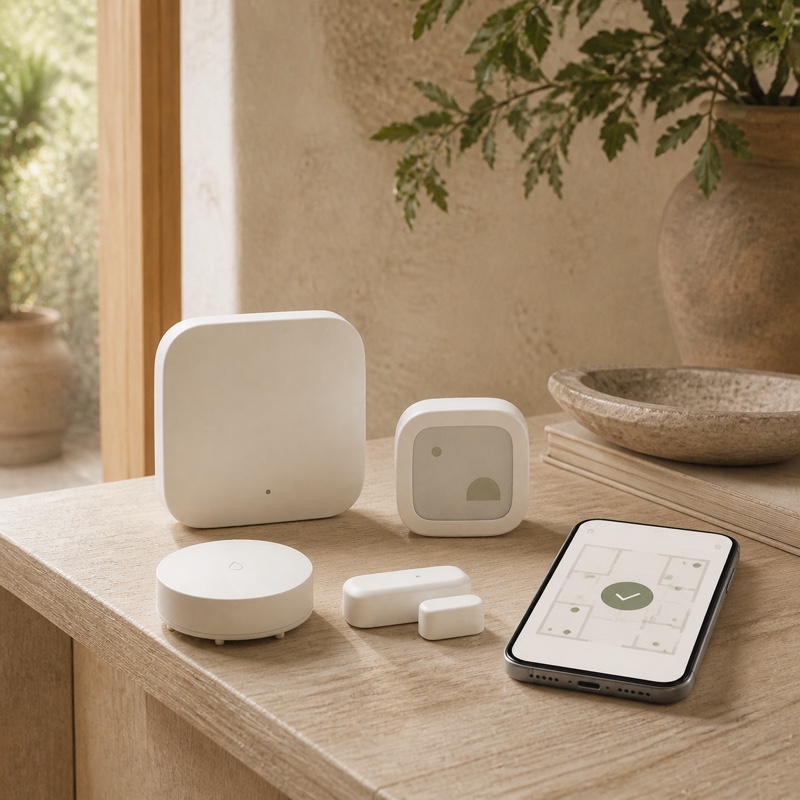
The system combines discreet sensors placed at selected points, an app for following the property and alerts designed to provide context. The local element becomes relevant when a signal cannot be clarified from a distance and it is safe to carry out a check.
Pulse is not about filling the home with technology. The setup starts with the property, the periods when it is unoccupied and the risks that concern its owner most.
Every sensor should answer a real risk
A kitchen, bathroom, outside door and humid room do not need the same type of monitoring. Before installing anything, it is important to understand where an early signal could genuinely change the response.
The gateway maintains communication between the equipment and the platform. The other sensors watch specific conditions without recording conversations or replacing a camera. A motion sensor, for example, may indicate activity in a defined area, but it does not identify a person or explain the movement on its own.
| Equipment | Signal monitored |
|---|---|
| Gateway | System connection and communication |
| Water leak | Water present at a risk point |
| Humidity and temperature | Persistent environmental changes |
| Door or window | A change between open and closed |
| Motion | Activity in a previously defined area |
A useful alert needs context
A single reading can be misleading. Humidity changes with showers, ventilation and the weather outside. A door may open because an authorised person entered. Motion may come from a person, an animal or the area chosen for installation.
A good alert therefore considers the type of signal, its duration, previous behaviour and the state of the other equipment. It should also distinguish a change in the home from a technical issue such as a low battery, lost connection or internet outage.
The owner should quickly understand where the change happened, when it began and what the next step might be. The aim is not to create anxiety with every reading, but to reduce uncertainty when something moves outside the usual pattern.
- The location and equipment that produced the signal.
- The time of the change and, where relevant, its duration.
- Battery, connection and gateway status.
- Enough history to compare with the home's usual behaviour.
- A clear next step: monitor, confirm or request local support.
From signal to action: closing the loop matters most
Receiving a water notification while you are in another country solves only half the problem. You still need to decide whether there is a simple explanation, someone should check the property or a technician or emergency service must be contacted.
With Laro Pulse, local response is designed as a continuation of the alert. Within the agreed scope, and when access is authorised and safe, Laro can observe the indicated point, document what is found and help coordinate the next step.
A local check does not replace the fire service, police, emergency services, security companies or qualified professionals. If there is danger, suspected crime, gas, fire, significant flooding or structural risk, the appropriate services must be contacted and nobody should enter an unsafe area.
What Pulse can see and what remains beyond the screen
Sensors are very good at detecting the conditions they were selected for. A water sensor can respond at that point; it does not confirm every pipe in the building. A contact shows that an opening changed state; it does not assess the lock, glass or outside of the home.
Some problems also have no immediate digital signal: smells, pests, accumulated post, damage after bad weather, a displaced roof tile or a subtle mark on a wall. This is why continuous monitoring and documented visits perform different, complementary roles.
Pulse is not a certified alarm system, technical inspection, guarantee against damage or substitute for maintenance. It is an additional layer of attention designed to make relevant changes more visible and support an informed decision.
A good installation prepares the response as well
Installation begins by understanding the home: available connectivity, vulnerable rooms, authorised access, patterns of occupation and people who may legitimately trigger motion. The right sensors, locations and alerts can then be defined.
Before leaving the property, it is worth testing every device and simulating a notification. The owner should know who receives the alert, how to contact Laro and when a local check or coordination with a professional is authorised.
- Choose sensors for concrete risks, not simply by quantity.
- Confirm gateway coverage, power and connectivity.
- Set limits and schedules that reflect how the home is used.
- Record contacts, authorised access and regular professionals.
- Test alerts, batteries and the response plan before an absence.
- Review the setup when use of the property changes.
Peace of mind does not mean receiving more notifications
Technology becomes useful when it fades into the background and appears only with information that helps. On a normal day, Pulse should let you confirm quickly that the home remains calm. On a different day, it should make the change clear and avoid leaving the owner alone to interpret an alert from afar.
That is the central idea behind Laro Pulse: attentive sensors, simple information and someone nearby when the screen is no longer enough.